
Know Every Student
Every student has a way forward.True Progress helps educators find it.
True Progress studies the most consequential problems affecting student learning and develops the research, assessments, and systems schools need to know every student clearly, know whether progress is happening, and know what to do next.
The Independent School Student Success Playbook
Practical guides for helping every student move forward
The Student Success Playbook turns research, experience, and work with schools into practical guides educators can use to understand students more deeply, make better decisions, and evaluate whether what they are doing is working.
Playbook Guide
The Difference Between Discussing a Student and Helping One
Playbook Guide
The Difference Between Discussing a Student and Helping One
Student support meetings can bring together experienced, caring educators and still produce little change for the student.
A practical system for moving from discussion to a clear hypothesis, a defined intervention, and a return to whether it worked.
Playbook Guide
Find the Power
Playbook Guide
Find the Power
When progress is flat, the problem may not be the student.
Use five intervention levers to examine whether the intervention had enough power to produce meaningful progress before drawing conclusions about the student.
Playbook Guide
Talking to Parents About Data
Playbook Guide
Talking to Parents About Data
Parents do not need a collection of scores. They need to understand where their child is, what the school knows, what happens next, and how the school will know whether it is working.
A practical system for turning student data into clear conversations with families.
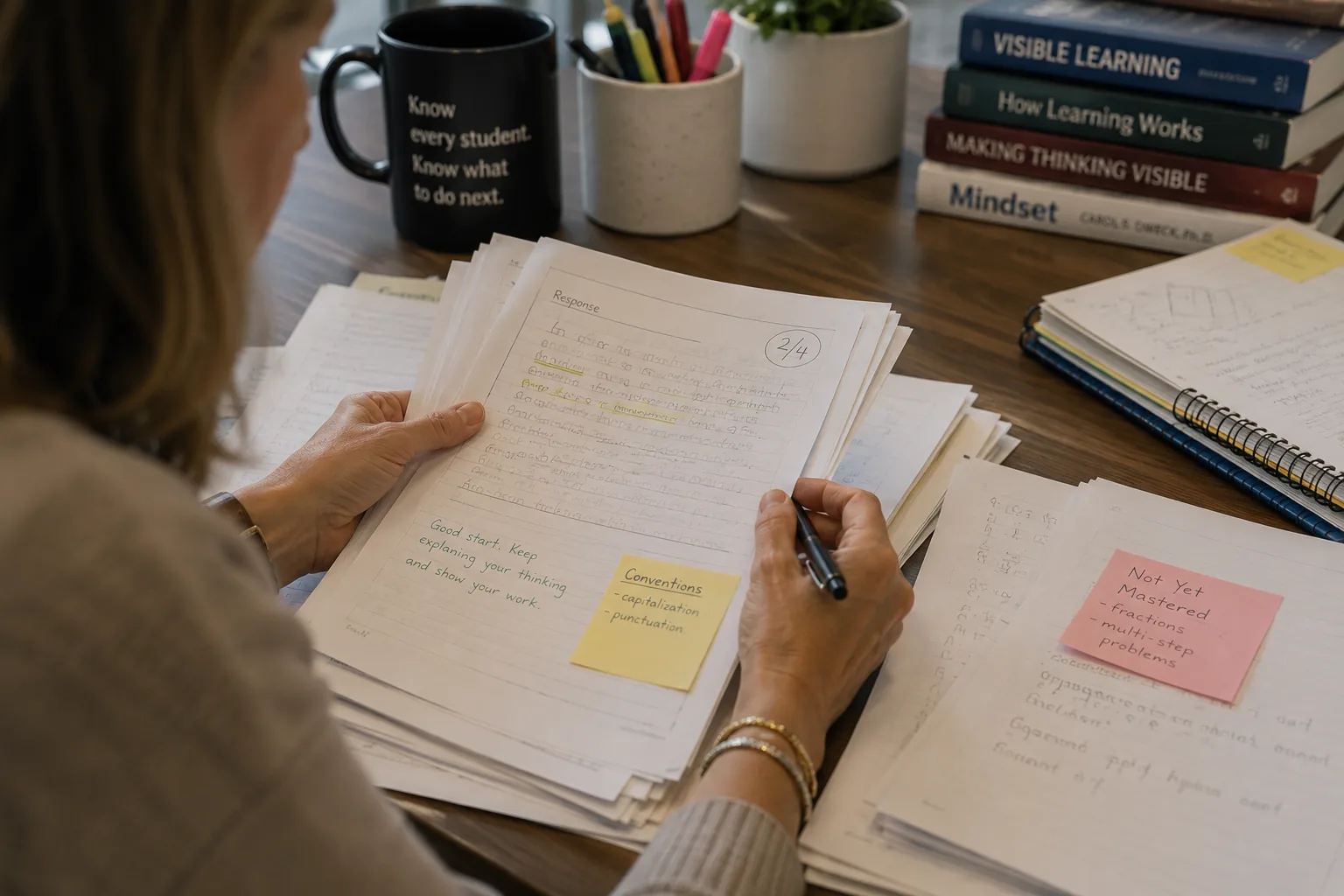
STUDENT PROGRESS
True progress changes what a student can do
Schools are full of evidence that looks like progress. Work gets completed. Scores rise. Students participate, comply, and move through the curriculum.
But activity is not the same as learning. Support can help a student finish today’s task without developing the capacity to succeed tomorrow.
True progress changes what a student can do independently — today, tomorrow, and long after the lesson ends.
HOW STUDENT SUCCESS WORKS
A continuous cycle of understanding and action
Knowing a student is not a one-time act.
Educators form a hypothesis about what the student needs, intervene, evaluate the effectiveness of that intervention, and use what they learn to revise their understanding of the student.
Then the cycle begins again.
- 01
Know
Understand the student as clearly as possible with the evidence available now.
- 02
Hypothesize
Form an explanation of what the student needs and what you expect an intervention to change.
- 03
Intervene
Take purposeful action intended to influence the student’s development.
- 04
Evaluate
Determine whether the intervention produced the change you expected.
- 05
Revise Understanding
Use what you learned to revise your understanding of the student, the need, and the original hypothesis.
- 06
Repeat
Form the next hypothesis and intervene again from a stronger understanding.
Back to Know
After Repeat, the cycle returns to Know.
Every intervention is both an effort to help the student and an opportunity to test the school’s understanding of what the student needs.
The five drivers of the Student Success System make this cycle possible across a school.
FIVE DRIVERS OF SUCCESS
- 1
Visibility
Seeing every student clearly.
Assessments, observation, and shared review deepen understanding of each student’s strengths, needs, and progress.
Explore Visibility - 2
Focused Curriculum
The right content, in the right order, for the right student.
A focused curriculum prioritizes essential knowledge and skills, builds them coherently, and responds to students’ actual levels and needs.
Explore Focused Curriculum - 3
Instruction
Teaching that responds as learning unfolds.
Through Formative Teaching, educators adjust instruction, practice, feedback, and challenge in response to what students understand and need next.
Explore Instruction - 4
Meaningful Data
From noise to direction.
Shared interpretation of evidence helps educators understand progress, judge whether teaching and intervention are working, and decide what needs to change.
Explore Meaningful Data - 5
Workflows
Making progress sustainable.
Clear roles and regular review points help educators coordinate intervention, follow through on decisions, and check whether students are making progress.
Explore Workflows

STUDENT SUCCESS SYSTEM
True progress doesn’t happen by chance. It happens by design.
The Student Success System brings together five connected drivers. Each addresses a different part of the work. Together, they create the conditions for every student to move forward.

TRUE PROGRESS SCHOOLS
True Progress Schools know every student
Every student has a way forward. True Progress Schools are built to find it — for the student who is struggling, the student working near the middle, and the student who is already well ahead.
Every student. Meaningful progress.
THE VISIBILITY PILOT
Begin with Visibility
Seeing clearly comes first.
There is no fee for the pilot. It is for one classroom, or one grade level. Two 25-minute assessments over three months.
Over three months, your school experiences the first driver of the Student Success System in practice. Educators develop a clearer understanding of how students learn, where progress has slowed, and what to do next.
By the end of the pilot, your school will know whether True Progress is the right long-term Student Success System for your students — and the pilot is designed to answer it.